Temperature Converter

Convert between Celsius, Fahrenheit and kelvin with offset-aware formulas, from °F = °C × 9/5 + 32 to K = °C + 273.15.

FluffyShield Protected workspace
From
To

Convert to

Units

Celsius°CFrom
Fahrenheit°F°F
KelvinKK

Other quantities have their own pages: Length, Mass, Area, Volume, Speed, Pressure, Energy, Power and Data size.

FluffyShield

Isolated workspace: other page scripts can't read your files. How FluffyShield works

Need a temperature on a different scale?

Different number, same temperature: 20 °C is 68 °F. FluffyBench's Temperature Converter turns your reading into Celsius, Fahrenheit or kelvin as you type.

How it works
  1. Pick your scale under From
  2. Pick the scale you need under To
  3. Type the number in Input value
  4. Read or copy the answer

Three scales

Celsius (°C), Fahrenheit (°F), Kelvin (K), in any direction.

Both other scales

Your reading also appears on the third scale below the answer, with its own Copy button.

Formula on show

Under the answer, the formula for your pair of scales is spelled out, along with what a 1 °C change is in °F.

Limits It won't warn you about a reading below absolute zero (−273.15 °C).

Why Celsius, Fahrenheit and kelvin show different numbers

Picture three rulers side by side, each with its own zero and its own step size. Every row across them is one temperature with three different names.
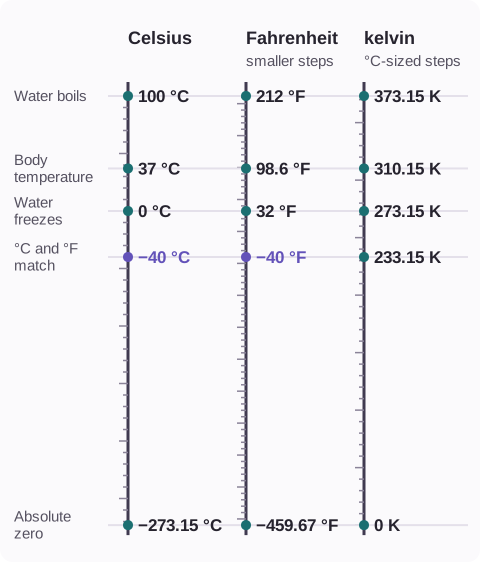
Absolute zero is 0 K = −273.15 °C = −459.67 °F. Water freezing is 0 °C = 32 °F = 273.15 K. The 37 °C body-temperature example is 98.6 °F = 310.15 K. Water boiling is 100 °C = 212 °F = 373.15 K. At −40, Celsius and Fahrenheit show the same number. The rulers are drawn to scale; Fahrenheit tick marks sit closer together than Celsius and kelvin marks.
Celsius and kelvin take same-size steps, but kelvin starts counting at absolute zero. Fahrenheit has its own zero and smaller steps. How we measured

Converting Celsius to Fahrenheit in FluffyBench

Here's a 20 °C reading turned into Fahrenheit, from choosing the scales to copying the answer.
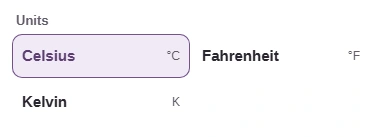
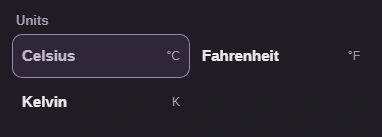
  1. The From list offers Celsius, Fahrenheit and Kelvin.
    The From list offers Celsius, Fahrenheit and Kelvin.
    Step 1. Open From and pick the scale your reading is in. Picking one closes the list.
    1. Choose Celsius for a °C reading.
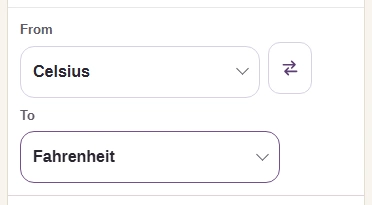
  2. From shows Celsius and To shows Fahrenheit, with the swap arrows between them.
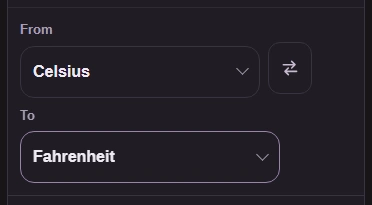
    From shows Celsius and To shows Fahrenheit, with the swap arrows between them.
    Step 2. To starts on Fahrenheit. Open it the same way when you need Kelvin or Celsius instead.
    1. From reads Celsius, the scale you have.
    2. To reads Fahrenheit, the scale you need.
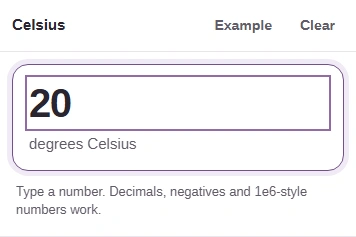
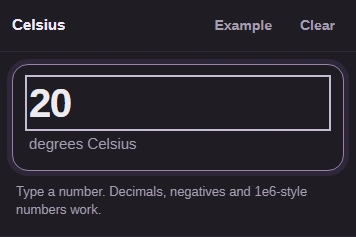
  3. Input value is 20 and its unit reads degrees Celsius.
    Input value is 20 and its unit reads degrees Celsius.
    Step 3. Type the number from your reading; there's no Convert button to press.
    1. Type 20 in Input value.
    2. The number is in degrees Celsius.
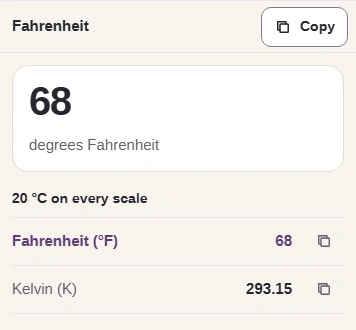
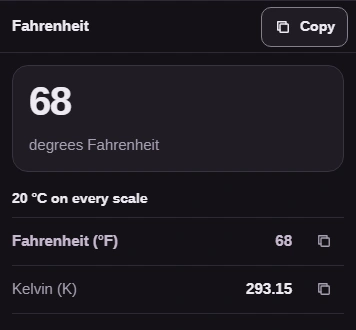
  4. The result is 68 degrees Fahrenheit with Copy above it; the list below shows 293.15 K.
    The result is 68 degrees Fahrenheit with Copy above it; the list below shows 293.15 K.
    Step 4. Copy gives the plain number, so add °F wherever you paste it.
    1. Read 68 degrees Fahrenheit.
    2. Copy takes 68, without °F.
    3. The same reading in kelvin: 293.15.

If you see “Enter a decimal number for Value.”, take the °C or °F out of Input value; the scale belongs in From. If FluffyBench says Copy was unavailable, select the result and copy it yourself.

What does Swap do to the number you typed?

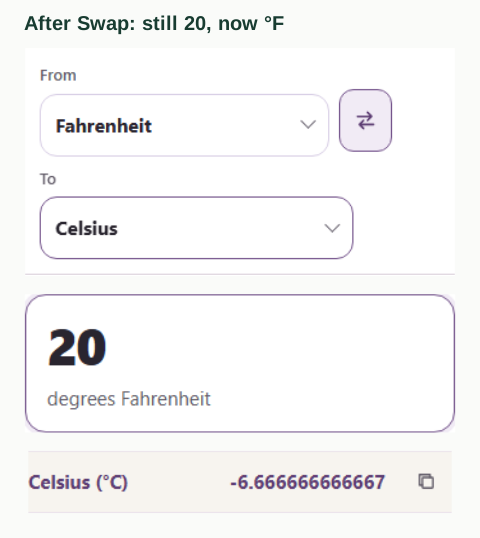
The arrows between From and To swap the two scales, but Input value keeps the 20 you typed. After a swap, that number means 20 °F, a different and much colder temperature.
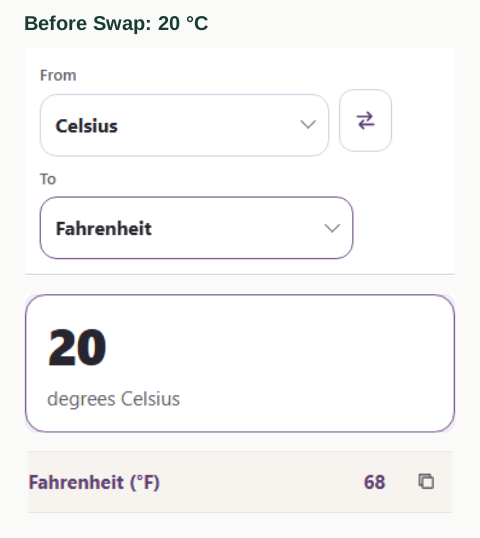
From Celsius, To Fahrenheit: Input value 20 degrees Celsius; the highlighted Fahrenheit row reads 68.

Before Swap

From Fahrenheit, To Celsius: Input value is still 20, now in degrees Fahrenheit; the highlighted Celsius row reads -6.666666666667.

After Swap

To turn your 68 °F back into Celsius, swap, then type 68 in Input value.

A reading of 20 degrees or a rise of 20 degrees?

A reading is one spot on a thermometer; a rise or drop is the gap between two spots. FluffyBench's Temperature Converter treats every number as a reading, so it's right for “it's 20 °C outside” but not for “it warmed up by 20 °C.”
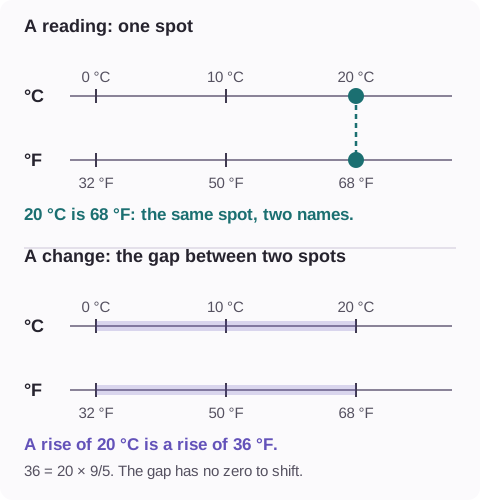
Top: a 20 °C reading lines up with 68 °F. Bottom: the gap from 0 °C to 20 °C is a rise of 20 °C, and the same gap on the Fahrenheit scale, from 32 °F to 68 °F, is a rise of 36 °F.
For a rise or drop, multiply by 9/5 to go from °C to °F, or by 5/9 to go back. A 20 °C rise is also a 20 K rise.

Converting pressure or energy instead?

FluffyBench's Temperature Converter works only with Celsius, Fahrenheit and kelvin. A tire pressure in psi or an energy figure in joules or calories goes in its own FluffyBench converter, so pick the one that matches your number.

Need to convert pressure units?

Need an energy conversion alongside a temperature reading?

Search FluffyBench